



It started as a question about my own skin.
I had already tried the strongest products on the market and my skin did not get better. So I stopped asking which product I should buy, and started asking two different questions instead: what is actually inside a plant, and how much of it ever reaches the skin.
I did not begin from nothing. My father started this formulation work and I grew up inside it, and I have carried it on. What I added was the ability to look inside the plant, and the years since have gone into doing exactly that.
Everything on this page is what I found.
Chrysanthi, founder and formulator
THE ORIGIN PLANT
Mountain tea is where this brand begins.
The Greeks called it sideritis, from sideros, iron. Look at where it chooses to grow and you understand why. It comes out of bare rock on the slopes of Olympus, splitting the stone to reach the light, the way only iron splits stone. A plant with that much force in it was never going to be gentle in what it makes. And the ancients used it as iron's answer as well as its equal: it was the herb they laid on wounds made by iron weapons.
When we ran our analysis, mountain tea was the only plant on the panel carrying compounds we found in nothing else. Two of them the reference library could not even name.
Two thousand years later, we still do not know everything that is inside it.

We did not choose most of these plants. Greek herbalists did.
People ask why we use these particular herbs and not others. The honest answer is that we did not choose most of them. Greek herbalists did, over two thousand years of watching what worked on skin. Theophrastus catalogued these plants. Dioscorides wrote down what each one was for. They had no instrument to look inside a plant, so they judged it the only way anyone could: by what it did.
We inherited that shortlist. What we added was the ability to look inside.
And where these plants grow matters, because it decides how much they make. Our herbs grow where the summers are dry, the sun is hard and the temperature drops at night. A plant under that kind of pressure has to make more of what protects it, and those are the same compounds your skin can use. The mountain tea that splits rock to reach the light is not a gentle plant, and that is exactly why we want it.
Some of our herbs we grow ourselves. Others we pick by hand in the Olympus area, each one in its own short window in the year, when it is at its strongest.
A small number of botanicals simply do not grow in a Greek climate. For those we work with the same trusted growers we have used for years, chosen the same way we choose everything else: by what the analysis shows is inside them.
What we never do is buy a ready-made extract from a catalogue and put our name on it. Everything in a DOS formula starts as a plant.

Sideritis scardica

Hypericum perforatum

Salvia Scarlea

Squalene

Calendula officinalis

Foeniculum vulgare

Lavandula angustifolia

Sea Buckthorn

Matricaria chamomilla

Hordeum vulgare

Brassica oleracea acephala

Theobroma cacao

Coffea arabica

Aspalathus linearis
We do not put herbs into a cream.
We build four herbal Elixirs, one for each kind of formula we make, and the products are built on those.
We combined these exceptional Greek herbs and created Elixir No.1, and with it we enhanced the antioxidant action of our day creams. Elixir No.2 was built for the demands of the eye area. Elixir No.3 goes into the night creams. Elixir No.4 protects the skin's natural pH in our cleansers.
Each Elixir is named for the herbs doing the most work in it. There are more inside. Elixir No.3, the one in our night creams, holds eleven.
-

No.1
Day creams
Mountain tea, St John's wort, calendula, lavender, red tea
-

No.2
Eye creams
Hypericum, fennel, chamomile, calendula, brown raw rice
-

No.3
Night creams
Mountain tea, St John's wort, calendula, lemon, coffee, olive leaves
-

No.4
Cleansers
Mountain tea, hypericum, calendula, chamomile, lavender


THE ANALYSIS
We measured exactly what is inside our herbs.
Most brands take their supplier's word for what is inside an extract. We do not, and this analysis was not bought from an agency either. I ran it myself, as part of my postgraduate research, at a research institute in northern Italy that specialises in the analysis of medicinal plants. I carried our own herbs there from our own lab, and I was in the room when the results came through.
We screened our herbs against a reference panel of 186 known phenolic acids and flavonoids. Ninety-nine of them were there.
11herbs analysed |
186compounds screened against |
99found |
Then we ran the blend. The richest single herb held 57 of those compounds. The herbs together held 72, more than any herb going into it, and three compounds appeared in the blend that we could not find in any herb on its own.
One thing we want to be clear about. This panel looks for one family of compounds. It is not the whole of a plant, and we would not claim it is. Some of our herbs are in a formula for what this panel does not measure: the beta glucans in barley, the tannins in knotgrass, what fermentation releases from kale. We measured what we could measure, and we are telling you exactly what that was.
WHOLE HERB, NOT ONE MOLECULE
Take one compound out of a plant and it stops behaving like the plant.
Ancient Greek herbalism worked with whole plants. Theophrastus catalogued them, Dioscorides wrote down what each one did, and none of them ever isolated a single molecule, because none of them could. The modern industry does the opposite. It pulls out one compound, standardises it, and throws the plant away.
We did not arrive at the whole plant as a philosophy. We arrived at it because our blend measured richer than any herb inside it, and because three compounds turned up in that blend that were in none of the herbs alone. The ancients used the whole plant because they had no choice. We use the whole plant because we measured it.
It is also why our ingredient lists are long, and why we publish every one of them in full. Each herb in a formula brings its own set of actives with it.
Our formulas are not a choice between the plant and the laboratory.
They are both, deliberately.
Hyaluronic acid holds water where the skin can use it. Marine collagen and elastin work together, which is rarer than it sounds, because most brands use collagen alone and leave out the protein that lets skin spring back. Palmitoyl tetrapeptide-7 signals repair rather than forcing it.
Niacinamide, vitamin C, kojic acid and licorice give us four separate routes to an even tone. Pigmentation almost never answers to one, which is why a single brightening active so often disappoints.

Our acids run as a ladder rather than a single strength: gluconolactone, gentle enough for reactive skin, then lactic and glycolic, then salicylic where the skin can take it. Nobody is excluded from renewal because their skin is sensitive.
And Chios mastic, the resin Greeks have used for two thousand years, is in our day cream as an active. Not as a story.
This is what our name means. Botanical science and pharmaceutical science, in one laboratory, held to the same test: does it work, and can we prove it.
What it is for |
What we use |
Why |
|---|---|---|
Hydration |
Sodium hyaluronate and hyaluronic acid, glycerin, panthenol, urea, squalane |
Water held in the skin, and a surface that stops losing it. |
Firmness |
Marine collagen, hydrolysed elastin, palmitoyl tetrapeptide-7 |
The proteins and peptides that keep skin springy rather than simply moist. |
Tone and dark spots |
Niacinamide, stabilised vitamin C, kojic acid, licorice extract |
Four different routes to an even tone, because pigmentation rarely answers to only one. |
Renewal |
Glycolic, lactic and citric acid, gluconolactone, salicylic acid, retinol |
Controlled turnover. Gentler acids for sensitive skin, stronger ones where the skin can take it. |
Calm and repair |
Allantoin, panthenol, Greek yogurt probiotic filtrate |
Support for skin that reacts, and for the microbiome that protects it. |
Greek actives |
Chios mastic oil, willow bark extract |
Where a Greek ingredient is also a serious active, we use it. Mastic is the clearest example. |
OUR ABSORPTION TECHNOLOGY
The best ingredient in the world does nothing if it sits on the surface.
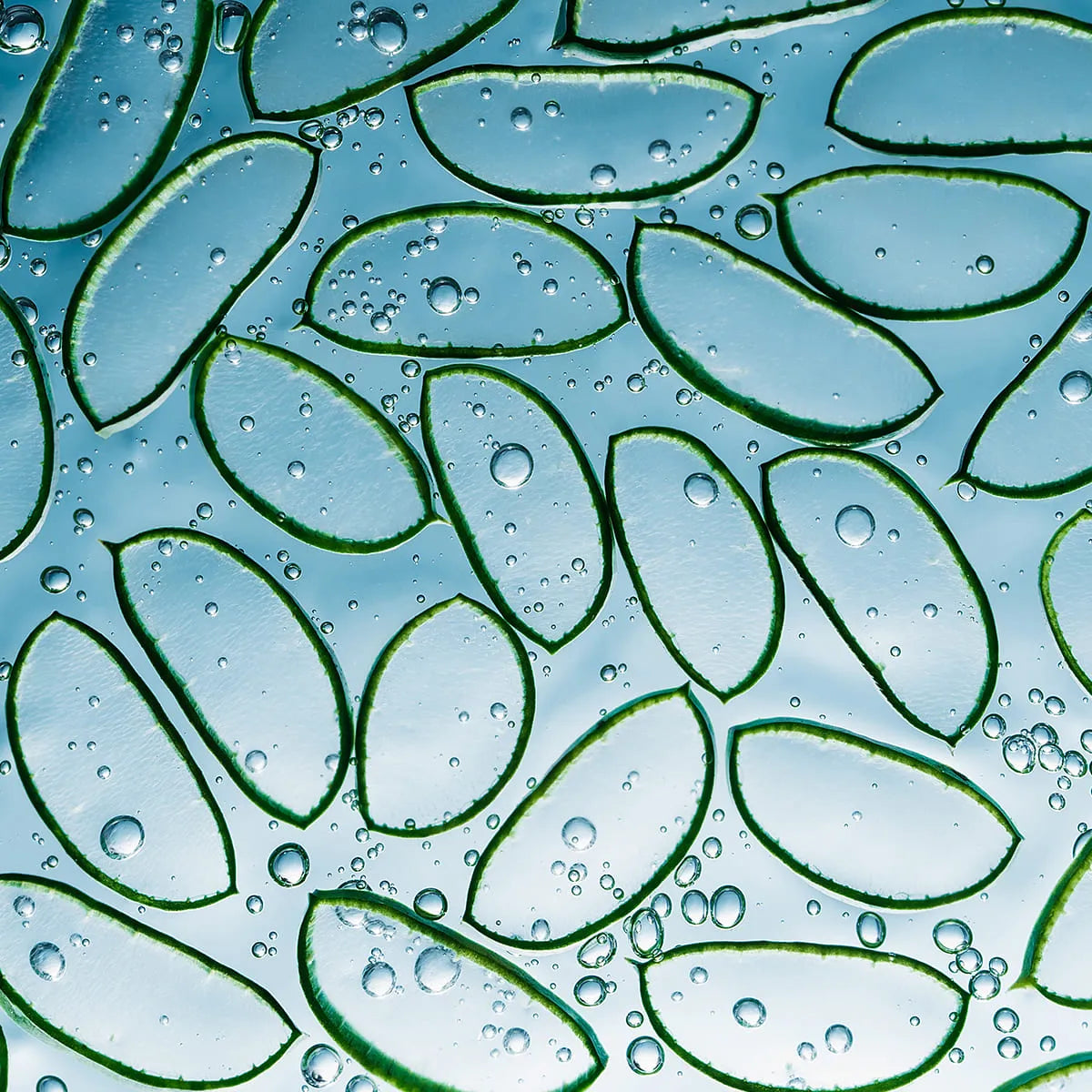
An active only works where it can reach. Most of what is in a plant extract never gets past the surface, because the skin is built to keep things out and plant molecules are large.
So before an active ever goes into a formula, we process it. In our own lab, we work with the herbs to minimize their size, so they can be better absorbed by the skin. We use natural carriers, which the skin barrier already recognises as its own kind. The skin does not read what arrives as a foreign body. It reads it as itself, and lets it through.
It is the slowest part of how we make a product, and it is the reason two creams with almost identical ingredient lists behave completely differently on a face.
OUR LAB
We are the manufacturer, not the customer of one.
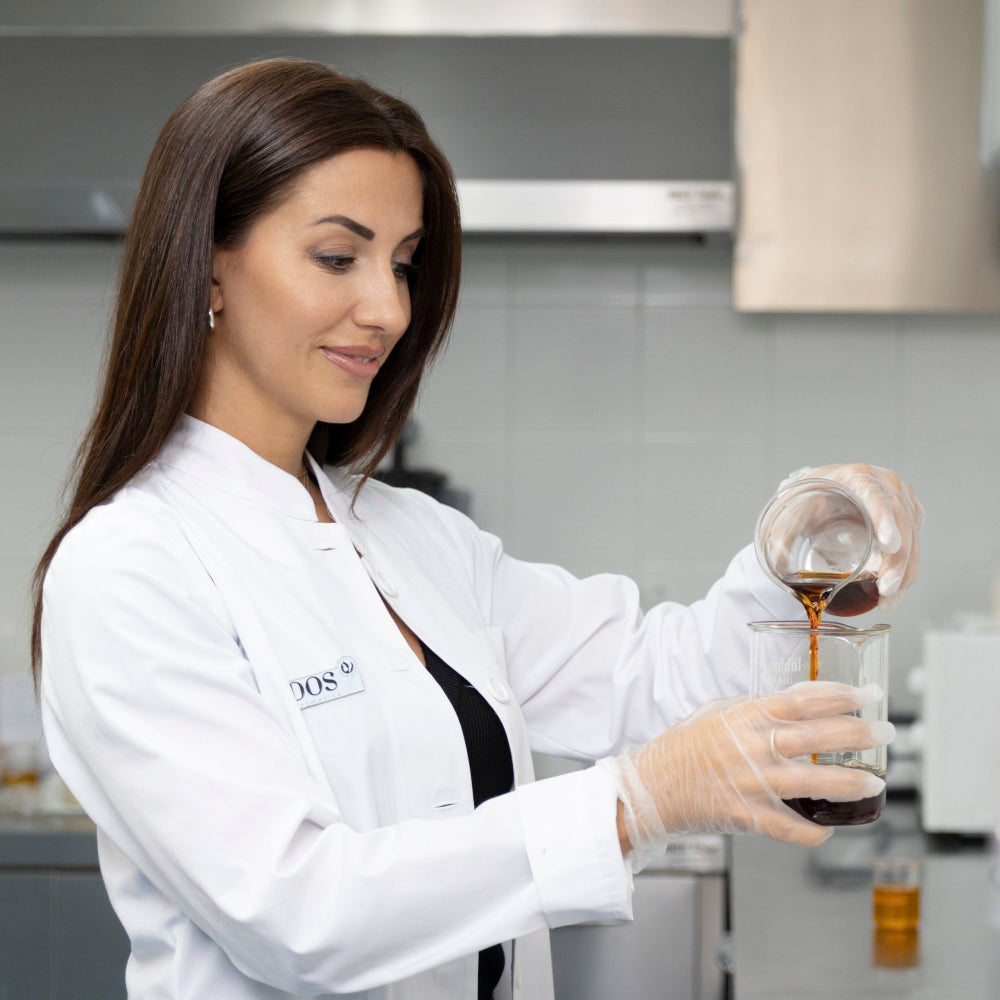
DOS is a family business. The research, the formulas, the way we rebuild the actives, the manufacturing: all of it happens in our own lab. Nothing at the centre of this brand is outsourced to anyone.
That matters for a very practical reason. When a formula is not performing the way it should, we change it ourselves, that week, instead of sending a request to a factory and waiting for an answer.
The herbs are Greek. The way we read skin is our own. The measuring is ours.
-

Our own research and development
-

Our own delivery process, developed in our lab
-

Manufactured to GMP standards in our own facility
-

Every formula tested before it reaches the market
-

Clinically tested for safety
-

Free from parabens and PEGs
-

Alcohol free
-

Safe, naturally derived fragrance, with every allergen declared in full
-

Every ingredient list published in full
-

Cruelty free


THE POINT OF ALL OF IT
Visible results in 7 to 10 days.
Everything on this page exists for one reason. Richer raw material, whole plants instead of single molecules, and actives rebuilt so that they get past the surface. Our customers tell us, again and again, that they see a difference within seven to ten days. We are comfortable putting that in writing, and we are not nervous about you holding us to it.
I have been an experienced user of active ingredients, retinal, acids, ascorbic acid, for many years, and my skin rarely notices a difference this fast. I was speechless when I got up in the morning and saw my face in the mirror. And this was the very first time I used it.
Elisavet T., 51
There is one condition. It has to be the right formula for your skin. A product built for dehydration will do very little for pigmentation, however good it is, and that is exactly where most skincare goes wrong.
So the question we have to answer before we recommend anything is not what is wrong with your skin. It is how your skin behaves.
That is a different way of looking at things. It reads the whole picture rather than the one thing going wrong this week, it follows the way your skin leans as the season changes, and it works towards balance instead of towards a quick fix. It is why our questions are about behaviour and not about labels, and it is the reason two people who arrive with the same concern do not leave with the same protocol.